Categories
E2E: Scale

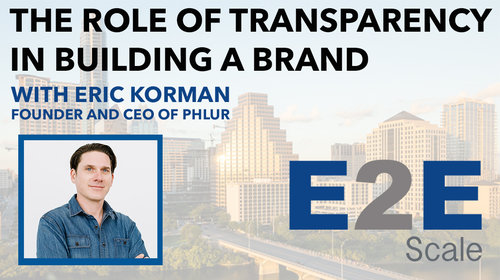
How Transparency and Becoming a B Corp Builds a Brand with Eric Korman

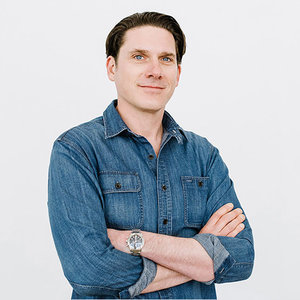
Eric Korman is the founder and CEO of Next Coast Ventures portfolio company PHLUR, a sustainable fragrance and candle brand.

What does it mean to be certified as a B Corp?

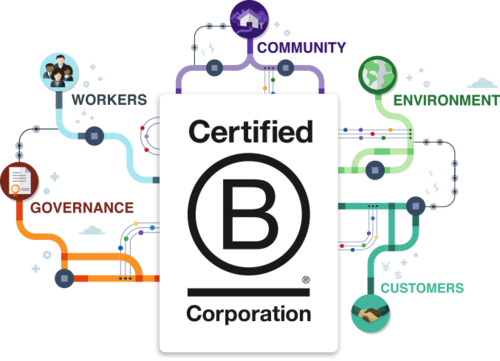
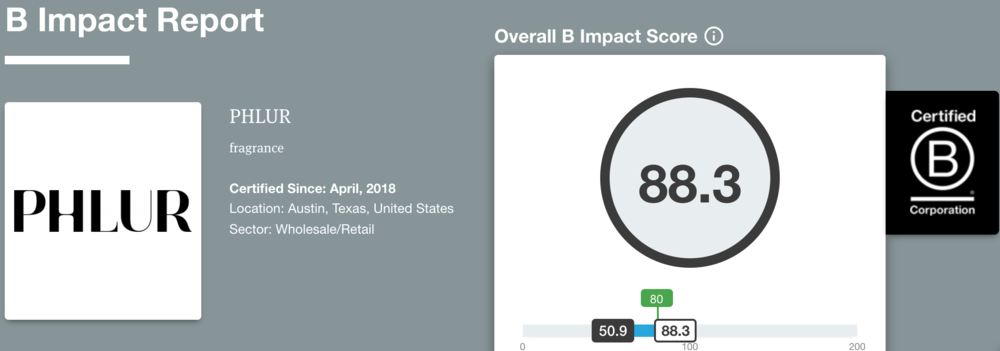
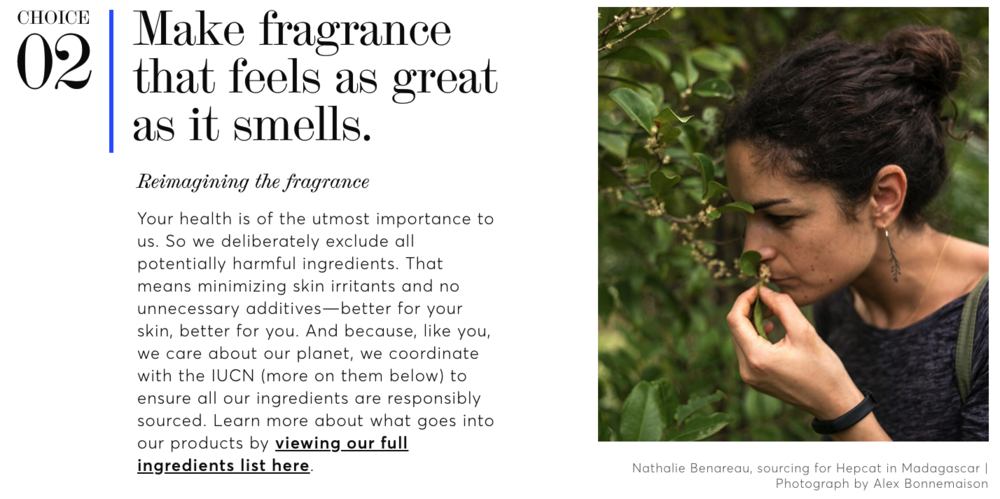
Well, since the start we made sure our sourcing decisions were made in alignment with the International Union for the Conservation of Nature, and we’ve had a give back program certified by 1% for the Planet, so now with the B Corp certification, we are further cementing our values as part of our corporate DNA. At a high level, a B Corp means optimizing your business by taking a multi-stakeholder approach to all your decisions instead of the traditional approach of only considering your shareholders as stakeholders. The interesting element of becoming a B Corp, is that by actually considering all of your stakeholders when you make business decisions, you ultimately create businesses that have higher returns to investors. Being certified also provides great partnership opportunities for like-minded organizations and targeted marketing opportunities to reach our customers.
At a lean startup with finite resources, how do you maintain a commitment to sustainability and transparency while still scaling a business?

To start, we made sure at least one of our founding team members had a deep background in sustainability and socially responsible practices. Part of her broadly-defined role was serving as goalkeeper to ensure that the decisions we were making upfront tied back to those values in the DNA of the brand. On a more ongoing basis, we’re taking the practices and the bones that she put into place and ensuring as we launch new products or look at a new partnership that we’re doing so through the same framework that she established. That doesn’t mean we don’t run into issues. Having values and intent doesn’t necessarily mean you’ll have all those priorities in practice on day one. You have to balance competing interests, and that’s what being a B Corp is about – considering all stakeholders does not imply satisfying all of them at once – that’s impossible. It’s simply going through the process of always trying to balance each individual decision in the best way possible, so that as a whole, things add up the right way.
Why do the extra legwork to become a B Corp?

It’s not a lightweight process, and as a startup we have plenty of things to do, so it certainly wasn’t going to be a day-one activity, but a couple of years in we felt that we were ready to undertake the certification. Ultimately, it adds a special halo to your brand, and speaks loudly to a specific group of potential customers. Customers who principally purchase from brands that are aligned with their value sets. Values such as sustainability, transparency and giving back to the community. If one of your goals is to be able to serve that constituency, I don’t think you can fake your way there. It doesn’t mean you necessarily have to be B Corp certified, but I do think it means consistently applying some specific values lens in everything that you’re doing that is going to ultimately touch the customer. We all fight so hard to acquire every customer that the last thing you want to do is lose a customer because something was very different than the way you positioned it originally. Do not get caught in those inconsistencies because the customer will ultimately figure it out.
What does it mean in practice to take a ‘multi-stakeholder approach’?

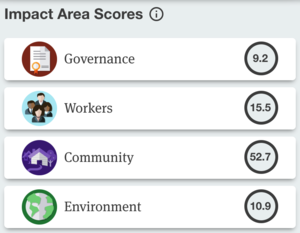
Essentially it means that you’re taking any decision as a business owner and looking at it as: How will this impact things like customers, our associates, team members and our community at large? That community can be the environment, or a community you’re physically part of, but it’s all the partners that you engage with as a business. So not only do you have to make decisions that collectively think about all these stakeholders, but you have to be transparent about how you make all those decisions, because by definition there is always going to be trade-offs.
What’s an example of how the B Corp certification process gauges your commitment to transparency?

One of the questions the B Corp certification process asks you is if you share your financial performance with all members of your organization – from entry level on up. Many organizations obviously don’t, the top leadership understands the company’s performance and nobody else has a full picture. While traditionally sharing that level of information was not done out of some misplaced fear, in reality sharing that information helps team members perform their roles better. Fundamentally, I believe team members perform better when they have context. And it’s simplest level, folks all across the organization need to make decisions without your involvement. How can they do so if they don’t even understand the basic financial structure and recent results of the business? Everything B Corp stands for ultimately goes back to how do you build a more creative and effective organization, which often is refreshingly the opposite of f typical business management conventions in a top-down, hierarchical structure.
How do initiatives like your give back program further your B Corp principles?

So interestingly we do not shout from the rooftops about our give back program. There are many customers who have no idea we have one, and we’re not spending a lot of time trying to change that aspect. Rather I believe the give back program is important as a grounding value of our company, and as we grow our team, I know it will be an important elements in terms of how we compete for talent at scale. It’s a great example of the multiple stakeholder approach. Because clearly giving back literally means were lowering our margin structure, but we believe it helps us attract better talent, which in turn helps us perform and compete better. I think employees want to be part of organizations that are giving back and are part of the community, there are countless studies that show that employees are driven to perform at their optimal level by elements that go well beyond simply cash compensation.
About Eric

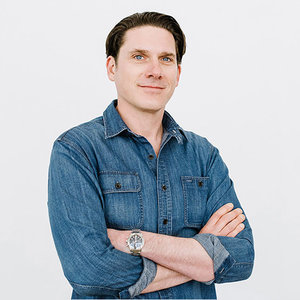
Eric is the founder and CEO of PHLUR, a vertically integrated fragrance retailer and Next Coast portfolio company. He is the former president of Ralph Lauren Digital and Global E-Commerce where he was responsible for the company’s digital businesses. Prior to Ralph Lauren, Eric was president of Ticketmaster Entertainment Inc. where he was part of the management team that drove the successful public spin-off of Ticketmaster from IAC (InterActiveCorp) in 2008. He later helped lead the merger of Ticketmaster with Live Nation. Previous to Ticketmaster, Eric was a strategy and corporate development executive at IAC. Eric has served on the Board of Directors of Points International (PTS), Active Network Inc., BET Digital and OpenTable Inc. (OPEN). He received his MBA in finance from the J.L. Kellogg Graduate School of Management at Northwestern University and his B.A. in economics from Emory University.


Categories
E2E: 20/20

SXSW Panel Preview: Digital Natives Disrupting Fragrance with Eric Korman

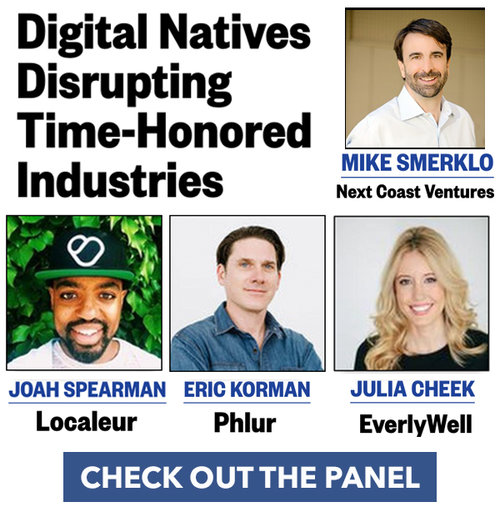
Next Coast Ventures co-founder Michael Smerklo will be moderating a panel on digital native disruption featuring PHLUR CEO Eric Korman during this year’s SXSW conference. The panel will focus on how the rise of digital consumers has upended many industries that were previously dominated by brick and mortar. Eric discusses what the audience can expect from the panel and how PHLUR, a Next Coast portfolio company, has come so far since last year’s SXSW conference.

Eric Korman, CEO of PHLUR

You’ve had a unique road to entrepreneurship spending the majority of your career in the corporate world, why was your idea for PHLUR the one that made you take the leap?

I started reading Fortune when I was 13 years old while other boys my age were reading Sports Illustrated, so the history of brand and branded products were always interesting to me. Many of the business ideas I had before PHLUR were easy to poke holes in or were coming to me at a time I was fortunate enough to have rapid career progression in the corporate world. But in the corporate world I was able to work on projects that were entrepreneurial in nature, constantly asking me to reexamine: ‘How does an existing business go back to market?’ I think the biggest difference this time was where I saw the internet as it related to brands. Prior to social media, the only brands that were created online were media brands like YouTube or Google, or aggregator brands like an Expedia, Match.com or Amazon. But with social media we saw digital first brands like Warby Parker emerge, and being a brand guy, that got me very excited. So I leveraged my 20 years of e-commerce experience with a brand background, and my interest in consumer products, and decided: well, maybe now’s the time.

Selling fragrance digitally was a radical idea, how did you paint the picture to investors?

There are so many reasons why big companies don’t innovate. For fragrance, considering to sell online is hard and it’s non-obvious how the experience should work. The hard and non-obvious didn’t feel like such a tremendous barrier for us, because I’ve seen watched so many different e-commerce verticals successfully shifted online. For instance, 15 years ago there were a lot of doubters that anybody was ever going to buy shoes online, and now Zappos is obviously a huge business, but shoe brands have been built digital-first like M.Gemi and others. So part of painting the picture for investors is to point to similar moments where there was a tremendous amount of doubt being able to shift online – and yet those few who did believe were able to create a lot of value. We’re also not the first company into the sampling economy, we’re leveraging the behavior that’s been built from the last five to six years, so we knew it would be something natural or comfortable for consumers.

As you develop your products and digital marketing strategy, what has been the best source for feedback? How did that change your business?

The biggest part of the feedback loop for us is the high level of engagement we get through Instagram and Facebook, it has provided us crucial insights early on. From the beginning, we took a specific approach to how we formulate our fragrance with clean ingredients and sustainable packaging, but our initial research concluded that “clean” messaging would not be a primary hook. Instead, our research said what will convince consumers will be the design of our packaging and the initial sampling experience. So we didn’t hide the fact that we removed a lot of the harmful products from fragrances, but we certainly weren’t leading with that message. But when we went to market. what we immediately heard from through our social channels completely contradicted the research. The commentary from the community was that they loved the transparent messaging, that we’re non-toxic, etc. That feedback pivoted early on how our brand message. So while it didn’t change how we were making the product – that was a core value – it changed how we communicated our value set.

What metrics did you look at once you launched to improve your business strategy?

A key part of our model is the percentage of customers that buy a full bottle after ordering our sample set. Originally, we had a two-fragrance sample, and while full bottle conversion was good, obviously we wanted it even better. So we started examining sample set behavior in a variety of ways. We realized people that were buying two sample sets were converting at a higher rate than those that were buying just one sample set and we dug in with those customers to understand why. That led to us relaunching with three samples in a box. It turns out, humans – from a behavioral perspective – are much better with three choices in front of them than two. It’s true across almost any category. So it started with the community speaking to us through their behavior, and I’m not kidding literally from the first day we launched three samples in a box, we saw the full-bottle conversion rate increase.

What do you see the role of social media influencers playing in your digital marketing strategy?

The influencer space is a challenging one and one that is always rapidly evolving. Five or six years ago brands that launched and were very influencer-savvy benefitted from a tremendous amount of really organic media. Now, paid influencers can be expensive because the market is highly competitive, with very large brands paying for influencers at scale – and now the largest influencers even have agents. So what worked for those brands a few years ago is not relevant today. Emerging brands have to build up a community and do a good job of organizing that underlying group in an effective way. That means identifying the collective thread of an audience that can be mobilized and get them excited to help spread a message on the brands behalf. Some of these influencers will have 50 followers while others will have 50,000. It’s a lot of work because you have to understand the underlying groups and it takes real man power to create programs like these. Organic doesn’t just happen organically.

What has been your biggest surprise in marketing to digital natives?

So there are plenty of historical precedents of a new generation rejecting the values, morals and behaviors of the parents. What’s interesting with digital natives is that’s certainly true, yet at the same time digital natives are influencing upwards – meaning their brand decision behavior is being mimicked often by the parents. As a result, we see strength with millennials, but also with an older audience as well. For example, we see moms with young kids very active in social media and being a very vocal proponent of our brand, doing selfie videos and posting them on Facebook. There’s a stereotype that all influencers are millennial, but age is not what determines someone’s influence per se.

About Eric

Eric is the founder and CEO of PHLUR, a vertically integrated fragrance retailer and Next Coast portfolio company. He is the former president of Ralph Lauren Digital and Global E-Commerce where he was responsible for the company’s digital businesses. Prior to Ralph Lauren, Eric was president of Ticketmaster Entertainment Inc. where he was part of the management team that drove the successful public spin-off of Ticketmaster from IAC (InterActiveCorp) in 2008. He later helped lead the merger of Ticketmaster with Live Nation. Previous to Ticketmaster, Eric was a strategy and corporate development executive at IAC. Eric has served on the Board of Directors of Points International (PTS), Active Network Inc., BET Digital and OpenTable Inc. (OPEN). He received his MBA in finance from the J.L. Kellogg Graduate School of Management at Northwestern University and his B.A. in economics from Emory University.
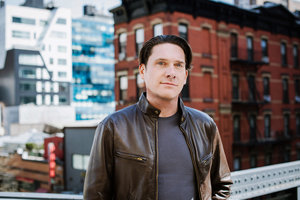
Eric Korman, CEO of PHLUR