
Categories
E2E: 20/20

SXSW Panel Preview: Digital Natives Disrupting Fragrance with Eric Korman

Next Coast Ventures co-founder Michael Smerklo will be moderating a panel on digital native disruption featuring PHLUR CEO Eric Korman during this year’s SXSW conference. The panel will focus on how the rise of digital consumers has upended many industries that were previously dominated by brick and mortar. Eric discusses what the audience can expect from the panel and how PHLUR, a Next Coast portfolio company, has come so far since last year’s SXSW conference.

Eric Korman, CEO of PHLUR

You’ve had a unique road to entrepreneurship spending the majority of your career in the corporate world, why was your idea for PHLUR the one that made you take the leap?

I started reading Fortune when I was 13 years old while other boys my age were reading Sports Illustrated, so the history of brand and branded products were always interesting to me. Many of the business ideas I had before PHLUR were easy to poke holes in or were coming to me at a time I was fortunate enough to have rapid career progression in the corporate world. But in the corporate world I was able to work on projects that were entrepreneurial in nature, constantly asking me to reexamine: ‘How does an existing business go back to market?’ I think the biggest difference this time was where I saw the internet as it related to brands. Prior to social media, the only brands that were created online were media brands like YouTube or Google, or aggregator brands like an Expedia, Match.com or Amazon. But with social media we saw digital first brands like Warby Parker emerge, and being a brand guy, that got me very excited. So I leveraged my 20 years of e-commerce experience with a brand background, and my interest in consumer products, and decided: well, maybe now’s the time.

Selling fragrance digitally was a radical idea, how did you paint the picture to investors?

There are so many reasons why big companies don’t innovate. For fragrance, considering to sell online is hard and it’s non-obvious how the experience should work. The hard and non-obvious didn’t feel like such a tremendous barrier for us, because I’ve seen watched so many different e-commerce verticals successfully shifted online. For instance, 15 years ago there were a lot of doubters that anybody was ever going to buy shoes online, and now Zappos is obviously a huge business, but shoe brands have been built digital-first like M.Gemi and others. So part of painting the picture for investors is to point to similar moments where there was a tremendous amount of doubt being able to shift online – and yet those few who did believe were able to create a lot of value. We’re also not the first company into the sampling economy, we’re leveraging the behavior that’s been built from the last five to six years, so we knew it would be something natural or comfortable for consumers.
As you develop your products and digital marketing strategy, what has been the best source for feedback? How did that change your business?

The biggest part of the feedback loop for us is the high level of engagement we get through Instagram and Facebook, it has provided us crucial insights early on. From the beginning, we took a specific approach to how we formulate our fragrance with clean ingredients and sustainable packaging, but our initial research concluded that “clean” messaging would not be a primary hook. Instead, our research said what will convince consumers will be the design of our packaging and the initial sampling experience. So we didn’t hide the fact that we removed a lot of the harmful products from fragrances, but we certainly weren’t leading with that message. But when we went to market. what we immediately heard from through our social channels completely contradicted the research. The commentary from the community was that they loved the transparent messaging, that we’re non-toxic, etc. That feedback pivoted early on how our brand message. So while it didn’t change how we were making the product – that was a core value – it changed how we communicated our value set.

What metrics did you look at once you launched to improve your business strategy?

A key part of our model is the percentage of customers that buy a full bottle after ordering our sample set. Originally, we had a two-fragrance sample, and while full bottle conversion was good, obviously we wanted it even better. So we started examining sample set behavior in a variety of ways. We realized people that were buying two sample sets were converting at a higher rate than those that were buying just one sample set and we dug in with those customers to understand why. That led to us relaunching with three samples in a box. It turns out, humans – from a behavioral perspective – are much better with three choices in front of them than two. It’s true across almost any category. So it started with the community speaking to us through their behavior, and I’m not kidding literally from the first day we launched three samples in a box, we saw the full-bottle conversion rate increase.

What do you see the role of social media influencers playing in your digital marketing strategy?

The influencer space is a challenging one and one that is always rapidly evolving. Five or six years ago brands that launched and were very influencer-savvy benefitted from a tremendous amount of really organic media. Now, paid influencers can be expensive because the market is highly competitive, with very large brands paying for influencers at scale – and now the largest influencers even have agents. So what worked for those brands a few years ago is not relevant today. Emerging brands have to build up a community and do a good job of organizing that underlying group in an effective way. That means identifying the collective thread of an audience that can be mobilized and get them excited to help spread a message on the brands behalf. Some of these influencers will have 50 followers while others will have 50,000. It’s a lot of work because you have to understand the underlying groups and it takes real man power to create programs like these. Organic doesn’t just happen organically.
What has been your biggest surprise in marketing to digital natives?

So there are plenty of historical precedents of a new generation rejecting the values, morals and behaviors of the parents. What’s interesting with digital natives is that’s certainly true, yet at the same time digital natives are influencing upwards – meaning their brand decision behavior is being mimicked often by the parents. As a result, we see strength with millennials, but also with an older audience as well. For example, we see moms with young kids very active in social media and being a very vocal proponent of our brand, doing selfie videos and posting them on Facebook. There’s a stereotype that all influencers are millennial, but age is not what determines someone’s influence per se.

About Eric

Eric is the founder and CEO of PHLUR, a vertically integrated fragrance retailer and Next Coast portfolio company. He is the former president of Ralph Lauren Digital and Global E-Commerce where he was responsible for the company’s digital businesses. Prior to Ralph Lauren, Eric was president of Ticketmaster Entertainment Inc. where he was part of the management team that drove the successful public spin-off of Ticketmaster from IAC (InterActiveCorp) in 2008. He later helped lead the merger of Ticketmaster with Live Nation. Previous to Ticketmaster, Eric was a strategy and corporate development executive at IAC. Eric has served on the Board of Directors of Points International (PTS), Active Network Inc., BET Digital and OpenTable Inc. (OPEN). He received his MBA in finance from the J.L. Kellogg Graduate School of Management at Northwestern University and his B.A. in economics from Emory University.

Eric Korman, CEO of PHLUR


Categories
E2E: 20/20

SXSW Panel Preview: Digital Natives Disrupting Healthcare with Julia Cheek

Next Coast Ventures co-founder Michael Smerklo will be moderating a panel on digital native disruption featuring EverlyWell CEO Julia Cheek during this year’s SXSW conference. The panel will focus on how the rise of digital consumers has upended many industries that were previously dominated by brick and mortar. Julia discusses what the audience can expect from the panel and how EverlyWell, a Next Coast portfolio company, has come so far since last year’s SXSW conference.

Julia Cheek, CEO of EverlyWell

EverlyWell has had a huge year since your last SXSW appearance in 2017, why do you think your company has had such good traction?

The reason why EverlyWell has resonated with consumers so quickly is because we took a consumer-first strategy, not a healthcare strategy. How do you take models that have worked in other areas and radically transform an individual’s healthcare experience? It’s driven by a combination of consumer demand, and frankly, building a platform that people didn’t even know they needed. We focus on e-commerce, digital as a delivery platform for lab tests and end-to-end consumer, and overlay that with the healthcare value proposition.

The SXSW panel is all about digital natives overhauling industries and healthcare is an industry that hasn’t quite experienced this yet, how did you paint the picture to investors?

Honestly, a lot of VCs rejected the investment when we were pre-revenue – it was hard to demonstrate real traction for very new model. I raised money from angel investors, and that was the money we used to launch the platform in beta. It’s a hard to raise money on a radical new concept, I’m really grateful that there were people that believed in the idea. Many VCs are, by design, quite risk averse and they have certain metrics that they’re looking for. They told me it was a cool idea, but nobody was going to buy the product because there were no companies doing it at this stage. But we’ve created the space. Now, 12 months later, it’s a very different story because our sales are verification that there is a huge market opportunity here. Note: Next Coast Ventures invested in EverlyWell’s latest round of funding.

What about millennials makes this self-testing product especially attractive to them?

Technology is radically changing the healthcare community in this country – look at the recent announcements from Apple, Amazon, etc. I think that’s due to a couple of factors. The economics of healthcare have radically changed, you’re no longer getting great quality healthcare that’s being paid for by your employer. There is also a self-care and wellness movement that is really targeted at the millennial generation. Now, the movement is driving people to use their disposable income on services that would have been doctor-focused in the past but are now consumer education-focused like 23andMe, Fitbit and lab testing like EverlyWell.

As you have adapted your marketing strategy, what has been the biggest surprise in growing your brand?

What surprised me was the purchasing behavior on digital platforms mimics non-digital behavior. The majority of healthcare spending on a family unit is managed by females, and our strongest customer base is females purchasing for their families. Typically, our main customer base is the older millennial, mainly women over the age of thirty. Another surprise was how powerful social advertising has been as a platform for us. Women refer the product, tag it on social platforms and suggest it to their friends. Online reviews and customer referrals are the new gold standard for consumer brands to build a reputation.

Does being an online-only platform inhibit your ability to build customer loyalty?

This was a hard product to sell without education. Less than five percent of Americans know that the home lab testing market exists, so there’s a huge lack of mass-market education. We still have a lot of education work to do whether that’s through home marketing or brick and mortar. Right now, I think that we’re at the tip of the iceberg, because although digital natives do most of their shopping online, you need to hit them through multiple points – exposing them to the brand several times as they consider the purchase. So eventually, to build broader brand awareness, you need to think about other mediums like retail to amplify the digital platform.

Where do you see your relationship with the healthcare industry going?

I think the consumer-driven healthcare marker is a huge hockey stick phenomenon you’re already seeing across multiple health services, but it’s not separate from traditional medicine. Our testing becomes part of their traditional doctor visit, working in tandem with their usual healthcare habits. When we started, there was quite a bit of physician resistance, but now 30-40% of customers were actually referred to us by their own doctors. Our lab testing is often times more cost effective, and doctors know if you have to go all the way to the lab and pay out of pocket, many patients won’t do it. So they send patients to products like ours instead.

EverlyWell's women's health testing kit.

Where do you look for feedback when evolving your digital marketing strategy?

From consumers that’s all we do, all we do is look at our consumer feedback and build new partnerships, new platforms and new products. Our drivers are what our consumers tell us. It’s always been about conversion to generating sales. They’re paying a lot of money and you have tough critics so it’s really easy to see what’s working and what’s not. From potential investors, everybody has an opinion of why a certain idea is not going to work. If founders listened to everybody telling them why their companies won’t work, no one would start companies. You want to be thoughtful and intellectually honest, but you also want to hone your ability to identify which feedback is critical and right – and which feedback can be ignored.

What has been the biggest lesson you’ve learned launching this company?

What I’ve learned the most is that initial user acquisition and retention engagement is an incredibly detailed, data-driven process. If you are not optimizing day in and day out, and really growth hacking the platform, you’re toast. Our team is constantly evaluating those metrics and trying to quantify what does and doesn’t work, and it is a never-ending process that our team is committed to. That’s our secret weapon.

About Julia

Julia is the CEO and Founder of EverlyWell, the Austin-based, next-generation health testing platform and Next Coast Ventures portfolio company. Julia was named the number one female entrepreneur to watch by CIO magazine for 2017. Prior to founding EverlyWell in 2015, Julia was the Vice President of Corporate Development and Strategy at MoneyGram International. Julia started her career in management consulting at Deloitte and went on to earn her MBA from the Harvard Business School, where she graduated as a Baker Scholar with high distinction. She also is a former multiple World Champion equestrian, officially retiring in 2009.

Categories
E2E: News

Diminished But Not Dead: Kitchen-Tech In A Post-Juicero World

Note: This article originally appeared on Crunchbase News on December 8, 2017 and was written by Mary Ann Azevedo.

Startups in the connected cooking device space hoping to serve up success may have some trouble getting funding.

After a number of high-profile failures in the sector (Juicero and Teforia, I’m looking at you) this year, venture capitalists seem to have gone from hot to cold on the sector.

Cooking The Numbers

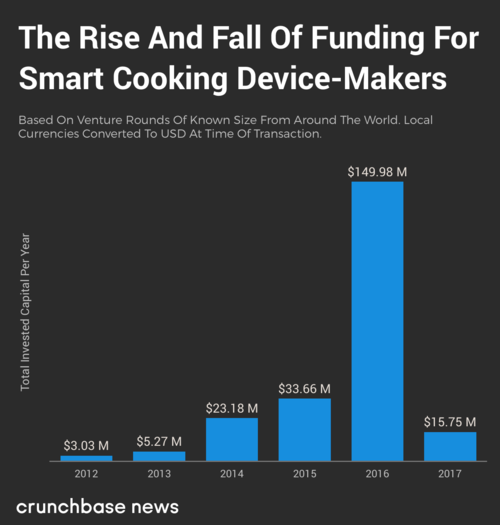
Global funding in smart food and drink prep devices increased by 10 times to $33.66 million from 2012 to 2015. The category then surged to nearly $150 million in 2016, according to Crunchbase data. However, investments haven’t kept up. So far in 2017, just $15.75 million has made its way into smart food and drink devices.

In September, San Francisco-based Juicero shut down after hauling in a total of $118.5 million in venture since it was founded four years prior. The self-described inventor of the first home cold-pressed juicing system raised $98 million of that funding haul in 2016 alone. That amounted to about two-thirds raised by the entire space for the year. A slew of investors, including Kleiner Perkins Caufield & Byers, Google Ventures, Thrive Capital, Two Sigma Ventures and Artis Ventures, pumped money into the company. (Two Sigma and Artis Ventures did not respond to requests for comment.)

Source: Crunchbase News.

Then, in October, Mountain View-based tea infuser startup Teforia also shuttered after raising $17.1 million in funding from investors such as Translink Capital and Upfront Ventures. (Upfront Ventures declined to comment.)

But it hasn’t been all doom and gloom in the sector. In February, sous vide Kickstarter darling Anova Culinary announced that Swedish appliance giant Electrolux had agreed to purchase the startup for $250 million. Anova’s mission is to build the Anova Kitchen, which it described as “a kitchen where devices are precise, dead-simple to use, affordable, and connected in a meaningful way.”

Not Well Done

There’s a number of theories as to why Juicero and Teforia didn’t survive, but the price point of each startup’s products likely played a central part.

Juicero’s second-generation juicer sold for $700 before the company cut the price to $400 back in January. By July, the CEO conceded it was still “too expensive.”

Teforia — which had been dubbed the Juicero of tea — was selling its internet-connected tea brewing machine for $1,000.

Some categories are doing better than others. Beer-brewing startups like PicoBrew, for example, are still in the game despite a $549 price point. That Seattle company has raised about $15 million.

So what makes one smart cooking device company more likely to succeed than another?

Mike Smerklo, Co-Founder and Managing Director of Austin-based Next Coast Ventures, believes “a pretty significant change in the way consumers interact in their home and their kitchen” is currently taking place.

His firm was one of a number of venture capital companies that invested in Newark, Cali.-based undisclosed Series B round in May. The startup – which vaguely describes itself as an IoT and domestic automation company that integrates technology and design to enable joyful experiences in the home, starting with the kitchen – also raised $12 million in September 2016.

“Though it’s super early, Brava is following a model that we think will be successful,” Smerklo told Crunchbase News. “They’re working to build convenient, reliable connected cooking devices and bring in aspects of social engagement over time.”

Smerklo believes the cooking industry is ripe for disruption.

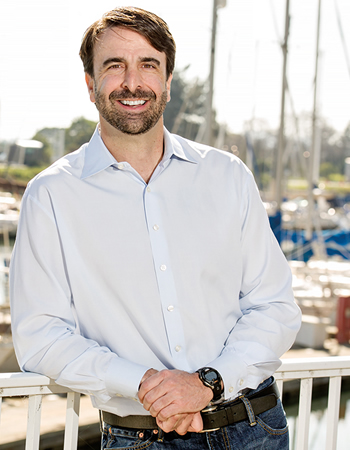
Mike Smerklo, co-founder of Next Coast Ventures.

“When you think about how you cook today, it’s largely been done with an oven or a grill or a recipe in a way that hasn’t changed much in the last 50 years,” he said. “But now you can drive temperatures up and down remotely and do a number of things that could not be done before.”

For the mass market to get excited about a smart cooking device, Smerklo believes the product needs to be a few things: reasonably priced, convenient and offer a differentiated experience. One point of differentiation could be increased social engagement, such as interactive cooking classes through your smart device.

“Could you be sitting around a cooking device and taking a cooking class, or getting recipe tips,” he said. “ Those things offer a significantly different experience than me sitting in my kitchen cooking by myself with a cookbook.”

Mike Wolf, publisher of The Spoon and creator of the Smart Kitchen Summit, believes the hardware market in general tends to see more high-profile failures than successes.

But some are doing well, he points out, such as Seattle-based ChefSteps, which says it’s on a mission “to help people cook smarter” via its website and companion app.

“It helps when companies can provide a product that a consumer sees as providing value for the amount of money they’re paying,” he told Crunchbase News. “And that presents a new way of cooking.”

He agrees with Smerklo that building and tapping into large communities is crucial. ChefSteps, he said, created its own community with cooking videos and then was able to sell into that community.

“Longer term, there’s a lot of innovation coming down the pike,” he said. “In Europe, they’re creating entirely new cooking devices but that hasn’t been brought down to the consumer price point in the U.S. yet.”

Both Smerklo and Wolf agree that Juicero’s problems stemmed from more than its high price points. It was also a product that didn’t appear to do anything very life-changing or spectacular.

“Plus, they kept the consumer captive in their ecosystem,” Wolf pointed out. “They might have had more success if they had opened it up to other people and partnered with say, Dole.”

In the case of Teforia, it started to see competitors marketing the same product at a lower price point, according to Wolf. That became a problem.

Ross Blankenship, managing partner and CEO of Dallas-based venture capital firm AngelKings.com, believes another issue with these types of companies are that many are just building one-off products rather than a platform from which other people can develop.

“People can figure out how to squeeze juice themselves so when needing to cut their budget, an expensive juicer might be considered an unnecessary item in their lives,” Blankenship told Crunchbase News. “But if you can build a platform that’s sustainable and that can weather a storm such as a recession, then you’ll have more success. Founders are thinking too short-term, and saying, ‘Look at my sexy product.’ But they need to think about how they are still going to be in existence 10 or 20 years from now.”

Whether investors continue to bet on this space remains to be seen. In the meantime, it’s clear that startups need to work harder to fulfill bigger needs in the kitchen.

Categories
E2E: Scale

Serial Entrepreneur and Next Coast Ventures Partner Zeynep Young Gives Tips on How to Succeed as an Entrepreneur

Zeynep Young is a serial entrepreneur who just became a venture capital partner with Next Coast Ventures.

In this Ideas to Invoices podcast, Young discusses what it takes to succeed as an entrepreneur and what she looks for when making an investment.

Previously, Young founded and served as CEO of Double Line Partners, an educational technology startup in Austin. And before that, she was portfolio director at the Michael & Susan Dell Foundation and an associate principal at McKinsey & Company.

Young is currently the CEO of milk + honey, a wellness and beauty company with a portfolio of day spas, salons and products in the organic, luxury market.

Alissa and Shon Bayer founded milk + honey in 2006 in Austin. The spa business has grown to five locations in Austin and Houston. Milk + honey is launching nationally, Young said. They also sell organic products like a natural deodorant online and through their stores, Young said.

After selling Double Line Partners to a private equity company, Young took a year off to spend more time with her kids and family. But she didn’t stay away for long.

“I think if you enjoy what you do it gets boring to be away from it,” Young said. “I love tech and I love spas and I love startups and I missed that. And it’s really fun to get back into business and starting talk about ideas that you’re really passionate about and working with people you really like.”

In the partner role at Next Coast Ventures, Young is looking for ideas where she can add a lot of value. The firm is built for entrepreneurs by entrepreneurs, Young said. Tom Ball and Mike Smerklo, founding partners of Next Coast Ventures, are both entrepreneurs who have built companies and taken them to an exit. Next Coast Ventures recently closed on a $85 million fund and is looking to invest in early stage entrepreneurs in the Austin area and similar tech markets.

“We look to invest in things that we really understand and have expertise in where we think we can add a lot of value beyond just the capital,” Young said.

At Double Line Partners, Young launched the company from zero dollars and grew it to $20 million in revenue from her dining room table. She spent six years as a bootstrapped entrepreneur building up the educational technology company before selling it.

Young will be looking at software, educational technology and retail startups.
Under 10 percent of venture funded companies are founded and led by women, Young said. There is opportunity there for VCs to reach untapped markets, she said.
“I think we should definitely have more women in venture capital and more women should get involved in,” she said.

That’s one thing that differentiates Next Coast Ventures. It is intentional around building diversity of experience, Young said.

Entrepreneurs pitching Young should have a customer focus. That’s the number one thing she looks for when making an investment.

“I think part of the thing I see missing in the space right now is that people who are first time entrepreneurs get very focused on raising the capital,” Young said. “And then the second thing they think about is how do I build a minimum viable product and then they start to think about the customers.”

As a bootstrapped entrepreneur, Young had to think about the customer every minute of ever single day.

“I think if that is sort of your third or fourth priority, it’s going to be very difficult to be successful,” Young said.

She doesn’t want to hear a pitch targeted to capital or how they are going to get the product done. She wants to hear about how they are going to reach customers.

What doesn’t play well with her is an entrepreneur talking about getting one percentage of a huge market. She wants to hear about specific customers.

It’s also important for an entrepreneur to understand the industry they are working in, Young said. They must have industry experience on their team, she said.

“I love innovative ideas that disrupt industries, but I think you have to know a little bit about the domain and the industry before you disrupt it,” she said.

Young also recommends that entrepreneurs work their network to find customers for their products and services as extensively as they work their network looking for capital.

And in the process, entrepreneurs will have to deal with a lot of rejection. But they should be open to the feedback from customers as well as investors.

“When you hear no, it doesn’t mean that the idea is bad,” Young said. “It’s just not for that person. Not every concept is right for every person.”

The sales process also is easier if an entrepreneur is passionate about what they are creating, Young said. But if an entrepreneur isn’t comfortable with that part of the business they need to add a team members who is, Young said.

“There’s no success without sales,” she said.