
Categories
E2E: Scale

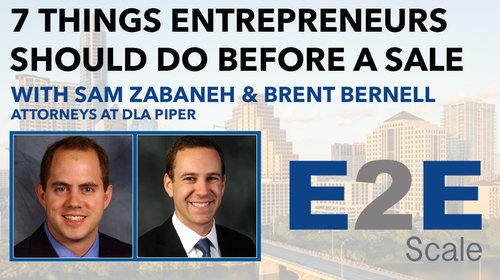
7 Things an Entrepreneur Should Consider Before a Sale

At Next Coast, we’ve been fortunate enough to have some portfolio companies that recently exited via acquisition and it’s given us a birds-eye view on just how important it is for entrepreneurs to prepare for such a big moment. The sale process is chaotic, unpredictable and stressful and must be managed alongside the day-to-day operations of a scaling a startup. So we reached out to the legal experts over at DLA Piper to give us the nitty-gritty details on what entrepreneurs should expect during this process – and how they can prepare for it. It’s detailed, but that’s exactly what you’d expect from a great legal team helping you cross your t’s and dot your i’s during the roller coaster of the sale process.

By Sam Zabaneh and Brent Bernell, DLA Piper

We see it every day: An entrepreneur builds an amazing business, navigates the perils of raising capital and reaches that transformational moment – the liquidity event – only to be confronted with the enormity of the process. While nothing can truly prepare an entrepreneur for their first sale of a company, we hear time and again from our clients about steps they wish they had taken earlier to make the process run more smoothly. Here are seven pieces of practical advice to help an entrepreneur prepare for this exciting moment:

1. Get organized

Entrepreneurs wear many hats, and bouncing between being head of product, vice president of sales, director of business development and chief people officer, they can sometimes forget how important it is to keep the legal side of their business in order. Entrepreneurs tell us that selling their companies made them wish that they had gotten organized sooner, and for one simple reason: due diligence. In a sale process, buyer due diligence can be a significant burden, particularly when coupled with negotiating the substantive deal points and running a business. Entrepreneurs can ease the burden by getting organized early and staying current. Entrepreneurs should create a contract log and organize all contracts, preferably into an electronic data room. This allows them to be more responsive with minimal effort when a buyer requests contracts for significant customers and vendors.

2. Understand your contracts

Entrepreneurs often tell us that they wish they had taken more time to understand the various contracts that they have already entered into as they built their businesses. As part of the sale process, the buyer and its attorneys will look through significant contracts to identify potential red flags. These can include terms that limit the company’s ability to expand its business (such as non-competition provisions), lock the company into always giving a customer its best pricing (often referred to as a “most-favored-nation” clause) or expose the company to significant potential liability (often through unlimited indemnification obligations). While the main goal should be to avoid these types of provisions, new companies must agree to them from time-to-time in order to close a big sale or secure an important relationship. Sophisticated buyers may find these red flags and make them a significant deal point that results in adjustments to the purchase price or requires special indemnities by the company in favor of the buyer. By understanding existing contracts and putting in place an organized and disciplined contracting approach (including signing authority), entrepreneurs can get ahead of these potential issues – and possibly avoid them altogether.

3. Don’t forget IP assignment agreements

Entrepreneurs are often diligent about the need for trademarks, copyrights and patents, but they often forget how important it is to make sure that the company’s intellectual property, or IP, is secured. During the sale process, a company’s intellectual property history, and how well the company has protected its assets, will be closely scrutinized by the buyer. A company will almost certainly have to prove that all employees and contractors (or at least all individuals that have generated IP) have signed an agreement to protect proprietary information and assign any intellectual property to the company.

Determining whether every employee and contractor has signed an agreement can be a burdensome task, and having gaps in the documentation can make a buyer nervous. Entrepreneurs need to be disciplined in having every employee or contractor sign an agreement and organize them in a central location. This will help entrepreneurs lock up their IP, give comfort to prospective buyers and minimize the risk that an entrepreneur has to concede value to a buyer or chase down current or former employees for IP assignments on the eve of a transaction. We provide our entrepreneurs forms of these agreements, often referred to as PIIAs or EPIAs for employees, and consulting agreements or MSAs for contractors.

4. Run your liquidation waterfall scenarios

As a company evolves, it may develop a complicated capitalization structure with different classes of stock and other convertible instruments (like warrants) that will need to be paid out in a sale transaction. The willingness of these different groups to consent to a deal will depend in large measure on what level of return they are receiving. Understanding how the money will be allocated in a sale transaction can be very complicated and can vary significantly depending on the valuation.

Building out a liquidation waterfall model and updating it for each financing round will make it easier to assess different opportunities and understand where the economic interests of their different stakeholders diverge. Although all companies will need to go through this exercise as part of the sale process, entrepreneurs that do this early will be better prepared to enter into negotiations, evaluate different proposals and manage their stakeholders to a successful closing.

5. Know your approvals

One thing that can come as a surprise to entrepreneurs is how many of their stockholders are required to consent to a sale of the company. Over the course of raising financing rounds, different classes of stock may negotiate for the right to block a sale of the company. Even if the stockholders from that class are no longer the most senior holders or actively engaged with the business, they could still hold those rights. Knowing what approvals are required in advance will help an entrepreneur manage outreach to the most important stakeholders and avoid any last-minute delays or surprises. Understanding the impact of these provisions can also allow entrepreneurs to hold the line during financing negotiations to avoid overly-complex approval processes.

6. Talk to your employees about equity

Employee equity is one of a company’s most important retention tools, and while most companies will discuss it briefly when giving out awards, they rarely provide education to employees about the awards and their terms. Entrepreneurs tell us that they wish they had been more proactive in discussing equity awards with their employees, including what happens upon a sale and how different scenarios can impact tax burdens. By doing so, they could have gotten ahead of the inevitable questions that pop up in the sale process and helped their employees maximize the value of their equity awards.

7. Build a deal team – before there is a deal

A sale opportunity can come out of the blue or it can be the result of a deliberative process, but both scenarios require entrepreneurs to have a team of trusted advisors to assist them during the process. While entrepreneurs will naturally look to their senior management team and board of directors to help them in the process – which they should – having skilled lawyers, bankers and accountants is equally important.

A company can always retain advisors after an offer comes in, BUT having someone you trust, who understands your business and can give you advice in advance of the offer, can be invaluable. Entrepreneurs often tell us that they would not have been comfortable relying on advice from even the most experienced advisors without that level of pre-existing trust.

While some of these items seem like common sense, we regularly hear from entrepreneurs that these seemingly simple actions are often overlooked as they keep their focus on building their businesses – leading to issues when sale negotiations are in the home stretch. By being proactive and planning ahead, entrepreneurs can better position themselves to get the most out of their sale transaction.

About Sam and Brent

Sam Zabaneh is a partner at DLA Piper LLP (US) in Austin, Texas and chair of DLA Piper’s Texas Corporate & Securities practice. Brent Bernell is a corporate associate in the Austin office. Together with the rest of the DLA Piper corporate team in Austin and across the globe, they help guide entrepreneurs and technology companies throughout their life cycle, from idea to public company or liquidity. You can find out more about how Sam, Brent and DLA Piper help entrepreneurs grow their businesses here.
Categories
E2E: Scale

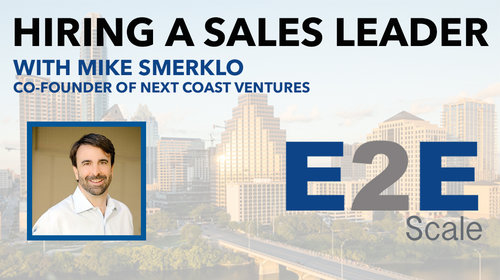
Know Thyself, Know Thy Leader: Steps To Hiring A Successful Sales Leader

Michael Smerklo

Many parts of scaling a business are about the basics, the time-honored fundamentals that CEOs have used time and time again to grow a company. These pillars of running a successful business rarely warrant exceptions, but there are some business functions that require a leader to develop their own formula for success — unique to their product and unique to their company culture.

This is especially true when it comes to picking a sales leader.

Take it from a former CEO that has lived the pain of this personally: Sales excellence and hiring great sales leadership is the most important determinant of success for a high-growth company looking to scale.

Unlike like other business initiatives — such as choosing a CRM system or designing the company’s web site — hiring a sales leader does not allow for a generic, one-size-fits-all formula. Rather, it is a unique learning process, one that each CEO must sit down and take an introspective look at to develop — and then learn to repeat. When approaching a complex business problem like this, the key is to peel back the layers to get to ‘first principles.’ From there, you can build a great business with the right leader for your specific sales process at the helm.

Along my entrepreneurial journey, I made a ton of mistakes with this challenge before finally nailing down the formula that led to a successful, scalable solution for finding my head of sales. Let me save you from making the same mistakes by sharing those growing pains.

At first, I did what most first-time CEOs do with sales hiring — I assumed that the only thing I needed to do was “hire the right Head of Sales”.

I was convinced that scaling the sales function was entirely dependant on making a great leadership hire so that is what i focused all of my energy on. And because I never hired a Head of Sales before, I relegated my interview process to time honored sales attributes — chronological resume review and basic questions about historical results and quota obtainment. This formula led me to fall in love with candidates that fit into a quintessential salesperson mold. Alas, I was dumbfounded when these great-on-paper hires failed at selling our software.

A prime example of this was the very first vice president of sales I hired — let’s call him Fred. Fred was one of the best interviewees I had ever met. He had long track record of sales success, extolled wisdoms about sale processes and swore up and down that he would hire an amazing team of ‘his guys’ that would drive us to sales greatness.

Well, Fred failed to sell anything, and his sales team of Fred carbon copies failed to sell anything either. So I fired him and found that not only had my business not scaled from a year earlier, I had actually gone backwards. So what went wrong?

It turns out I didn’t really understand my own customers’ buying process at all. Don’t get me wrong, I was deeply involved with our customers and understood our value proposition cold. But Fred never stood a chance because I hadn’t done my own objective research on what it would take to build a repeatable, scalable sales process of our unique ‘buyer’s journey’ for the organization.

How was a sales leader supposed to optimize the sales process when we didn’t even understand what our sales process was — and what it wasn’t?

This realization brings me to the first step of this process. And step one, like most business challenges for young CEOs, starts with stepping back and reflecting. Reflecting on what is truly unique about your business and the needs of your customers.

Start with simply determining how you are winning at sales. You do that by looking at the very end — the closing of the sale — and working your way backward. Ask yourself some basic questions about your product, who closes the sale, and how they got there. If you, as CEO, are heavily involved in sales, what do you specifically do in the process to help close the sale? Are you selling a transactional, high volume solution or a large, complex enterprise product? What attributes of your solution matter most: ease of implementation, financial benefits or cutting-edge technology?

Essentially: think about what makes the ultimate buyer say ‘yes,’ and painstakingly map out every step of the process from there.

An integral part of guiding this mapping exercise entails looking at your very best sales leaders and spending time understanding what they do to be successful. Is the sales leader enlisting a team with scrappy, cold-calling tactics or is it interconnected industry veterans that are networking their way into a sale? Is depth of product or industry knowledge key to sales success, or is it more important to build compelling financial models to win the day? Nailing down these sales leaders’ strategies is when your unique formula starts to take shape.

The next step gives your formula its teeth, it does this by taking the proven sales process and mapping out what attributes are needed in a head salesperson for them to be successful — and to a lead a team that will be equally as successful.

Identify the repeatable techniques and personality traits of the sales representatives that allows them to win at selling your product. Only then can you begin building a recruiting, hiring and training program that is tailored specifically to test for these attributes in a sales leader. This is crucial, because many CEOs try and clone the first principles that the sales process and your company culture rely on. However, it is cloning the attributes and techniquesthat nourish those first principles that allow your sales leadership thrive with your specific process.

For instance, looking back at my mistake at hiring Fred, it was clear I didn’t really know why and how we were winning sales with our product. I hadn’t mapped out the attributes necessary to make our sales leader successful in our particular brand of sales. So how in the heck was good-on-paper Fred supposed to come in and champion a sales process we didn’t even understand?

When analyzing what your optimal ‘Fred’ is like, it can be just as important to know which attributes you don’t want as it is to know which attributes you do want in a sales leader. There are many ways to vet these potential executives to see if they have the personality, techniques and experience to succeed in your particular formula for proven-sales glory. We liked a case-method of interviewing, but there are others like personality assessments or role playing sales scenarios that can force interviewees out of their classic salesman routines and into your specific buying process.

Once you have decided on an interview process and appointed a successful leader, be sure to track your sales leader and their team’s success over a six, twelve and eighteen-month period. Make sure that the formula you invested so much time, energy and hard work into is still getting it right. As market conditions shift, you may need to develop a formula 2.0, but as long as you are committed to understanding the unique ways the sales team works with your product, there is no reason you can’t consistently have a thriving sales leader at the helm.

Don’t cut corners with this seemingly tedious and elongated plan — and don’t assume that scaling sales is all about making one great hire.

Getting sales right is the key to taking your idea, dream or emerging growth to the next level. Only by knowing thy self will you be able to know thy sales leader when you see them.

Categories
E2E: 20/20

Utilizing Your Board with Richard Lebovitz

Richard Lebovitz is the founder and CEO of LeanDNA, an Austin-based AI platform and Next Coast portfolio company. As part of our E2E: 20/20 series with our portfolio CEOs, we spoke with Richard about utilizing your board’s expertise. Read more of our E2E content on governance here.

What has been the biggest benefit of working closely with your board?

For me, the board has always been helpful because when you’re an entrepreneur, you get wrapped up in the day-to-day grind. Anybody who says it’s easy is wrong, it’s not, you have so many roadblocks. But at the board level, you have people working with a lot of different companies and it’s great because they provide a birds-eye view on what doesn’t work with other businesses. I’m a bit more conservative than other entrepreneurs and I like to get things a little more perfected before I turn up the gas and go faster. However, with a board, I’m more comfortable going faster because they’ll help us avoid bad mistakes. Without the board, we only could have learned these lessons through trial and error.

Richard Lebovitz
CEO of LeanDNA

How can you make sure board meetings are as productive as possible?

The number one thing is to make it easy for the board to give you productive advice. It’s my job to make their job easier, so before each meeting I always ask myself: How do I present things in a way that allows them to give us good advice? These guys are busy and jumping around between 10 to 15 companies, so that means not a lot of PowerPoint slides or hiding any information, because who does that help? You want to get as much useful information as you can from them so it’s up to you be transparent, know what the issues are and ask for help where you need it. Think through those questions in advance and ask for targeted advice. Specifically, I like to pick a particular theme for each board meeting and drill down with the board to really talk about how to solve that issue.

What was something you struggled with building your business that your board eventually helped solve?

Changing the sales process was a critical step that we wouldn’t have been able to do without our board. We started out with these 25-page sales proposals with details about the complexity of our product and how it compared to competitors, etc. We would cite case studies and customer reviews because when you’re pitching a new product, your instinct is to give as much information as possible to help them make a decision. And yet we were struggling with exciting clients on our new product. Then one of our board members who came from a totally different industry with a lot of experience in marketing recommended that we change our sales pitch to a quick and simple approach. Since our best edge is our product, he recommended we skip right to that. So we went from a 25-page proposal to a simple one-pager and essentially going straight into a demo during the pitch. You wouldn’t think it would make such a big difference, but it really did. Once clients realized how easy it was to use and implement the product, they were significantly more likely to purchase it.

How did your board recommend you maintain this positive change in the sale process?

We started mapping out “a day in the life” of somebody that uses our product. We looked at the challenges they faced after purchasing our technology and then instituted a very tight relationship between our sales and customer service teams. When the salespeople got to see the product through its implementation phase, and the issues our clients experienced when expanding its use, they had a lot more ammunition when they went back to cold calling and trying to close new customers. The board is great at making sure we have the right processes like these in the place to be successful. A lot of startups typically aren’t great about making sure these measurements are being monitored once you close a deal. What happens after the customer signs? A board can be great at helping pick which aspects of your business to monitor and track in order to ensure success.

About Richard

Richard is the founder and CEO of LeanDNA, an Austin-based lean technology company that focuses on the manufacturing and industrial sectors. He was previously the founder and CEO of Austin-based Factory Logic, Inc. (acquired by SAP), which he started in 1997. He is also a board member for the Association for Manufacturing Excellence (AME), and is an Entrepreneur-In-Residence and Instructor for The University of Texas at Austin.

Categories
E2E: Scale

Serial Entrepreneur and Next Coast Ventures Partner Zeynep Young Gives Tips on How to Succeed as an Entrepreneur

Zeynep Young is a serial entrepreneur who just became a venture capital partner with Next Coast Ventures.

In this Ideas to Invoices podcast, Young discusses what it takes to succeed as an entrepreneur and what she looks for when making an investment.

Previously, Young founded and served as CEO of Double Line Partners, an educational technology startup in Austin. And before that, she was portfolio director at the Michael & Susan Dell Foundation and an associate principal at McKinsey & Company.

Young is currently the CEO of milk + honey, a wellness and beauty company with a portfolio of day spas, salons and products in the organic, luxury market.

Alissa and Shon Bayer founded milk + honey in 2006 in Austin. The spa business has grown to five locations in Austin and Houston. Milk + honey is launching nationally, Young said. They also sell organic products like a natural deodorant online and through their stores, Young said.

After selling Double Line Partners to a private equity company, Young took a year off to spend more time with her kids and family. But she didn’t stay away for long.

“I think if you enjoy what you do it gets boring to be away from it,” Young said. “I love tech and I love spas and I love startups and I missed that. And it’s really fun to get back into business and starting talk about ideas that you’re really passionate about and working with people you really like.”

In the partner role at Next Coast Ventures, Young is looking for ideas where she can add a lot of value. The firm is built for entrepreneurs by entrepreneurs, Young said. Tom Ball and Mike Smerklo, founding partners of Next Coast Ventures, are both entrepreneurs who have built companies and taken them to an exit. Next Coast Ventures recently closed on a $85 million fund and is looking to invest in early stage entrepreneurs in the Austin area and similar tech markets.

“We look to invest in things that we really understand and have expertise in where we think we can add a lot of value beyond just the capital,” Young said.

At Double Line Partners, Young launched the company from zero dollars and grew it to $20 million in revenue from her dining room table. She spent six years as a bootstrapped entrepreneur building up the educational technology company before selling it.

Young will be looking at software, educational technology and retail startups.
Under 10 percent of venture funded companies are founded and led by women, Young said. There is opportunity there for VCs to reach untapped markets, she said.
“I think we should definitely have more women in venture capital and more women should get involved in,” she said.

That’s one thing that differentiates Next Coast Ventures. It is intentional around building diversity of experience, Young said.

Entrepreneurs pitching Young should have a customer focus. That’s the number one thing she looks for when making an investment.

“I think part of the thing I see missing in the space right now is that people who are first time entrepreneurs get very focused on raising the capital,” Young said. “And then the second thing they think about is how do I build a minimum viable product and then they start to think about the customers.”

As a bootstrapped entrepreneur, Young had to think about the customer every minute of ever single day.

“I think if that is sort of your third or fourth priority, it’s going to be very difficult to be successful,” Young said.

She doesn’t want to hear a pitch targeted to capital or how they are going to get the product done. She wants to hear about how they are going to reach customers.

What doesn’t play well with her is an entrepreneur talking about getting one percentage of a huge market. She wants to hear about specific customers.

It’s also important for an entrepreneur to understand the industry they are working in, Young said. They must have industry experience on their team, she said.

“I love innovative ideas that disrupt industries, but I think you have to know a little bit about the domain and the industry before you disrupt it,” she said.

Young also recommends that entrepreneurs work their network to find customers for their products and services as extensively as they work their network looking for capital.

And in the process, entrepreneurs will have to deal with a lot of rejection. But they should be open to the feedback from customers as well as investors.

“When you hear no, it doesn’t mean that the idea is bad,” Young said. “It’s just not for that person. Not every concept is right for every person.”

The sales process also is easier if an entrepreneur is passionate about what they are creating, Young said. But if an entrepreneur isn’t comfortable with that part of the business they need to add a team members who is, Young said.

“There’s no success without sales,” she said.

Categories
E2E: Scale

Should the customer success function report to the head of sales or the CEO?

For any recurring revenue business, there are seven key reasons why the Customer Success function should report directly to the CEO and NOT the Head of Sales.


Customer success has (finally) started to become an established function within SaaS companies. As a startup begins to scale and move from ideation/product creation phase into revenue generation, it quickly becomes clear that resources are needed to help manage customer relationships AFTER the initial sale.

I have been an advocate of Customer Success and the importance of both the function and mindset within SaaS/Recurring Revenue companies since dinosaurs roamed the Silicon Valley…

As recurring revenue business models have become the standard for technology companies, it has become clear that Customer Success is critical for sustaining growth, profitability and customer reference-ability. In short, if you don’t get Customer Success right, nothing else matters.

As a result of this increased importance, it has been refreshing to see most emerging-growth companies building out functions that focus on all aspects of Customer Success – from onboarding and adoption to support and eventual renewal of the subscription agreement. This function can also take on responsibility for upselling and/or cross selling of additional seats or subscriptions.

In short, this is a critical function for any SaaS/Recurring Revenue business.

But here is the question I get asked more often than not about this function – should this function report directly to the CEO?  My quick answer – why wouldn’t it?

The normal response from CEOs that I work with goes in one of two directions:

  • Well, revenue is involved (cross sell, up sell, renewal) so my Head of Sales is arguing that it should report to her.
  • I already have so many direct reports (sales, CFO, product management, engineering, HR, marketing) that I can’t imagine adding another direct report.

My response is pretty simple and direct (before making sure, of course, that I remind EVERYONE that I was once a CEO so whatever I say must be 100% accurate)….What is the ONE THING that will make or break the success of your business? Hard to answer with anything here EXCEPT Customer Success!

Here are THE seven KEY reasons why Customer Success should report to the CEO:

  1. VISIBILITY: It lets you see exactly what is happening with your most important asset besides your employees: your customers.
  2. CLARITY: Having Customer Success separate from Sales gives the organization visibility into what is really happening after a prospect becomes a customer – and takes away a lot of the typical finger pointing between sales, product management / engineering and professional services.
  3. METRICS: When the Customer Success function reports directly to the CEO, an organization can develop specific metrics that really determine the health of the customer BESIDES how much money they are spending (i.e., sales).
  4. BALANCE OF POWER: In most emerging-growth SaaS businesses, the power within the organization typically sits first with product/engineering (“we need to build something that works”) and then shifts to sales (“we are screwed if we don’t sell something”). By having Customer Success sit OUTSIDE of either of these functions, a CEO can avoid a lot of the natural power plays that happen (resource gathering, budget disputes, etc.) and stay focused on the customer.
  5. SALES FOCUS: If Customer Success reports to the Sales function, there is too much potential for either the customer getting ignored (“I have to make the quarter”) OR the customer’s needs becoming a distraction (“We missed our f#cking quarter because of these customers”). The sales team’s job is to sell – keep it that way.
  6. FEEDBACK LOOP: As a CEO, one of the hardest things to do is to get clarity on what is really happening inside and outside the business. The ultimate is to get insight into what is happening in the magic loop – Plan and Build (product management and engineering) vs. Demand and Sales (Marketing and Sales) vs. Customer Experience (Customer Success).
  7. SIGNALING: By having this function report to the CEO, it tells the world (internal and external) that the organization really does care about the customer. It’s pretty hard to say “the customer is king” when the function isn’t sitting in the Monday morning Executive Staff meeting.

The advent of the Customer Success function is refreshing to see for technology companies, and the industry has come along way from the early days of “sell now, beg for forgiveness later” mindset.

By making the Customer Success function a direct report to the CEO, the long-term health and wellbeing of a business is significantly enhanced.

And it also takes one more excuse away from those Sales Executives when they miss the F#cking quarter – that fact alone might make it all worthwhile.