

Categories
E2E: 20/20

Diversity and Inclusion with Erik Larson

Erik Larson is the CEO and founder of Cloverpop, a Next Coast portfolio company and decision-making platform based in California.

Why is it so important for companies to quantify diversity and inclusion in the workplace?

If you don’t measure it, it won’t get better. Right now, measurements are weak or don’t measure actual business performance, especially when it comes to inclusion. When we started doing this research I found the general lack of ROI calculations when it comes to diversity kind of shocking. There’s very little direct measurement of the ROI of diversity, and most importantly the critical role inclusive decision-making plays in unlocking that ROI. Measuring this is critical because unless companies keep track of who is involved in decision-making, our research proves that diverse perspectives are not included, and thus the biggest benefit of a diverse workforce is unrealized. The status quo persists just because we’re not aware of this inclusion gap. Companies think they are succeeding when in fact they are making very little progress. Direct measurement reveals the problem, and motivates change.

Erik Larson, CEO of Cloverpop

What was the most surprising result from your research?

That the much bigger problem is the inclusion problem. Our research found that diversity without inclusion, can actually be a drag on the business. There’s more difficulty communicating within the team which creates more operational friction. Companies are spending billions on these diversity initiatives but aren’t realizing the full ROI because they aren’t working on the inclusion piece. Right now, less than half of the decision-making teams in a typical tech company involve women. This shocking lack of business savvy that is obvious as soon as you do even simple measurements. Not only does excluding women reduce the decision-making effectiveness of those teams, but also women who are underutilized in decision making are less fulfilled and less engaged. It’s not an explicit conspiracy, but it’s exclusion that is inevitable without management measures and controls.

What were you most surprised by when you began your research with looking at your own company specifically?

We first started our research by measuring ourselves and I thought we were going to be awesome, but when we measured our inclusion we actually had this big gap, specifically a 30% gap in gender. I was blindsided by it and I think that most CEOs and senior executives would be surprised by their results as well. We thought we were addressing the problem by hiring female leadership positions, but that didn’t do enough. The problem wasn’t that we needed new diversity hiring initiatives, the problem was that the people who were already present were not getting involved. The cool thing is we found it can be fixed really quickly if you measure it — it’s just a blind spot problem. We had to actively and explicitly say that in our culture, we include different perspectives because we know it leads to better decision making, and as soon as we started measuring these decision-making inclusion rates and reviewing them in our leadership meetings, the gap started closing. Within six months we were able to completely close the inclusion gap, because we knew it was there and we had a tool to fix it.
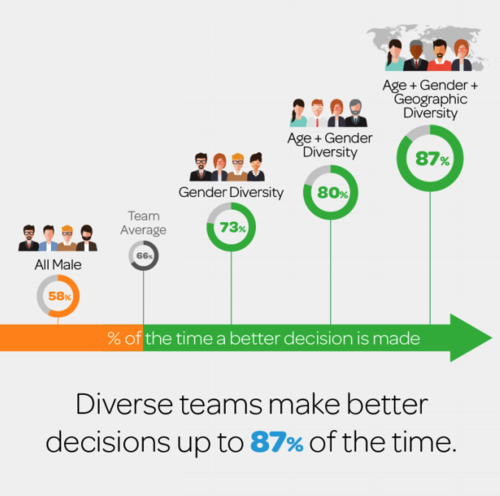
Data gathered from Cloverpop's Hacking Diversity initiative.

What would you say to entrepreneurs about the importance of diversity and inclusion that are scaling their businesses?

When you’re first starting a business, it can be hard to think of diversity and inclusion as a crucial piece to scaling your business. But as soon as you hire the first person outside of that founding team, you are fooling yourself if you think diversity is not an important decision. If you’re not thinking actively about diversity, you will run into culture problems and hiring problems. It’s shortsighted. When your company hits 10 or 20 people, that’s when culture starts to gel, and the last thing you want is a bro culture, or a narrow team with a narrow overlapping network that makes it harder to hire people by referral. Thinking about inclusion early on and pursuing it actively is a strategically smart thing to do.

Given how much toxic work environments have been in the news recently, where do you think we are in the lifecycle of creating inclusive workplaces?

I’m hoping that the dialogue will move from rhetoric to action, which will broaden the focus from moral imperatives to also become more about business performance. Often inclusion is a behavioral problem, not an evil-people-in-charge problem, and it’s bred through vague performance measures and inadequate action, not through malice. There are clearly bad actors, and the news recently has taught us that are especially bad apples in charge at some companies. But I think just as executives are held accountable for missing on profits and revenue in general, they should be held responsible for underperforming because of lack of diversity and inclusion in particular. Too often diversity and inclusion initiatives are started out of fear, for compliance or risk management or good PR. They should really be about improving fundamental business performance, engagement and competitiveness. If companies insist that they are going to change their approach diversity and inclusion, but they have no direct ROI metrics in place to measure it, then they’re not taking it seriously. Period. When companies start bragging about their ROI measures, then things will change. I believe these issues are too mainstream, and the ROI is too large, for that not to happen soon.
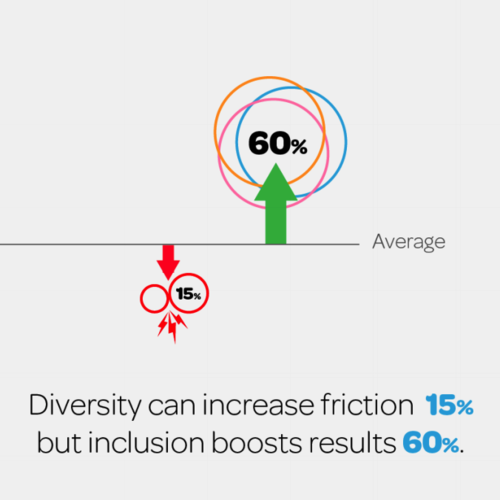
Data gathered from Cloverpop's Hacking Diversity initiative.

About Erik

Erik is the founder and CEO of the decision-making platform Cloverpop. He spearheaded their latest diversity and inclusion project titled ‘Hacking Diversity.’ Prior to that, he spent the past decade launching a dozen v1.0 SaaS products at Adobe and Macromedia. He is a decorated U.S. Air Force captain that attended MIT before getting his MBA at Harvard Business School.


Categories
E2E: News

Announcing Our New Entrepreneur in Residence and Two Technology Venture Partners

Today, we are very excited to announce some additions to our team that echo our commitment to building out a firm with a continual thesis around how can we bring the best and brightest minds to the entrepreneurs that we serve. We are adding Paul Rogers and Jim Dunham as Technology Venture Partners, and Adam Salamon as our very first Entrepreneur in Residence.

One of the things we were adamant about when we founded Next Coast was that we leverage our network of industry experts to help our portfolio companies reach new levels of growth. Our leadership already has such diverse expertise – whether it’s bootstrapping a business or taking a company public, we’ve been there. But the people that we are bringing into our network are aren’t just company builders, they are game changers. They are going to help us provide the insight, strategy and support to give our entrepreneurs the edge they need to be successful in this competitive landscape.

Jim Dunham has been in the technology industry for over 25 years and most recently served as the president of cloud and business intelligence at ServiceSource, a San Francisco-based software company. Paul Rogers is an alumni of Google and currently serves as chief technology officer of New York-based Namely Inc., an HR data platform.

Jim Dunham

Technology Venture Partner

Paul Rogers

Technology Venture Partner

Prior to Namely, Paul served as the chief technology officer of Austin-based RetailMeNot Inc. and as the vice president of engineering and operations at Austin-based Bazaarvoice Inc.

At the highest level, Paul and Jim are going to be our technology experts deep in product management and product engineering. They are going to be able to help our portfolio companies with their technology platforms, product market fit and how they can scale their technology.

Entrepreneur in Residence Adam Salamon most recently served as the founder and chief operating officer of Perk Inc, a mobile-first rewards and engagement platform that went public on the Toronto Stock Exchange before being acquired by RhythmOne PLC earlier this year. It is important to our firm’s culture to have a strong entrepreneur in our office helping us evaluate investment opportunities and figure out what they want their next project to be. Adam is a great entrepreneur with a strong track record and we want to be part of what he does next.

Adam Salamon

Entrepreneur in Residence

All of these additions are going to be bringing more resources to our entrepreneurs. We are formalizing this commitment by launching the Game Changers section on our site, where this growing advisory network will share their expertise, insights and reflect on the current investment landscape.

Check out our most recent post by our Venture Partner and Game Changer Zeynep Young. She reflects on Austin’s entrepreneurial community aiming for the ‘sweet spot’ and how startups can set themselves apart in the hunt for investment dollars.

Categories
E2E: Scale

Should the customer success function report to the head of sales or the CEO?

For any recurring revenue business, there are seven key reasons why the Customer Success function should report directly to the CEO and NOT the Head of Sales.


Customer success has (finally) started to become an established function within SaaS companies. As a startup begins to scale and move from ideation/product creation phase into revenue generation, it quickly becomes clear that resources are needed to help manage customer relationships AFTER the initial sale.

I have been an advocate of Customer Success and the importance of both the function and mindset within SaaS/Recurring Revenue companies since dinosaurs roamed the Silicon Valley…

As recurring revenue business models have become the standard for technology companies, it has become clear that Customer Success is critical for sustaining growth, profitability and customer reference-ability. In short, if you don’t get Customer Success right, nothing else matters.

As a result of this increased importance, it has been refreshing to see most emerging-growth companies building out functions that focus on all aspects of Customer Success – from onboarding and adoption to support and eventual renewal of the subscription agreement. This function can also take on responsibility for upselling and/or cross selling of additional seats or subscriptions.

In short, this is a critical function for any SaaS/Recurring Revenue business.

But here is the question I get asked more often than not about this function – should this function report directly to the CEO?  My quick answer – why wouldn’t it?

The normal response from CEOs that I work with goes in one of two directions:

  • Well, revenue is involved (cross sell, up sell, renewal) so my Head of Sales is arguing that it should report to her.
  • I already have so many direct reports (sales, CFO, product management, engineering, HR, marketing) that I can’t imagine adding another direct report.

My response is pretty simple and direct (before making sure, of course, that I remind EVERYONE that I was once a CEO so whatever I say must be 100% accurate)….What is the ONE THING that will make or break the success of your business? Hard to answer with anything here EXCEPT Customer Success!

Here are THE seven KEY reasons why Customer Success should report to the CEO:

  1. VISIBILITY: It lets you see exactly what is happening with your most important asset besides your employees: your customers.
  2. CLARITY: Having Customer Success separate from Sales gives the organization visibility into what is really happening after a prospect becomes a customer – and takes away a lot of the typical finger pointing between sales, product management / engineering and professional services.
  3. METRICS: When the Customer Success function reports directly to the CEO, an organization can develop specific metrics that really determine the health of the customer BESIDES how much money they are spending (i.e., sales).
  4. BALANCE OF POWER: In most emerging-growth SaaS businesses, the power within the organization typically sits first with product/engineering (“we need to build something that works”) and then shifts to sales (“we are screwed if we don’t sell something”). By having Customer Success sit OUTSIDE of either of these functions, a CEO can avoid a lot of the natural power plays that happen (resource gathering, budget disputes, etc.) and stay focused on the customer.
  5. SALES FOCUS: If Customer Success reports to the Sales function, there is too much potential for either the customer getting ignored (“I have to make the quarter”) OR the customer’s needs becoming a distraction (“We missed our f#cking quarter because of these customers”). The sales team’s job is to sell – keep it that way.
  6. FEEDBACK LOOP: As a CEO, one of the hardest things to do is to get clarity on what is really happening inside and outside the business. The ultimate is to get insight into what is happening in the magic loop – Plan and Build (product management and engineering) vs. Demand and Sales (Marketing and Sales) vs. Customer Experience (Customer Success).
  7. SIGNALING: By having this function report to the CEO, it tells the world (internal and external) that the organization really does care about the customer. It’s pretty hard to say “the customer is king” when the function isn’t sitting in the Monday morning Executive Staff meeting.

The advent of the Customer Success function is refreshing to see for technology companies, and the industry has come along way from the early days of “sell now, beg for forgiveness later” mindset.

By making the Customer Success function a direct report to the CEO, the long-term health and wellbeing of a business is significantly enhanced.

And it also takes one more excuse away from those Sales Executives when they miss the F#cking quarter – that fact alone might make it all worthwhile.