

This post originally appeared on Michael Smerklo’s Forbes blog on May 24, 2019.
'"People are busy. There are six billion people on the planet yet none of them wake up in the morning and think: ‘Geez, I wonder if there is a new product out there I should know about.'"
-Marc Andreessen interview on Brian Koppelman’s podcast
As a venture capitalist, I’m fortunate enough to be pitched by startup companies with exciting new businesses every day, each one convinced that they are building a massive business or claiming to disrupt billion-dollar marketplaces. It’s a familiar feeling. As a former CEO, I was constantly being pitched new solutions that would claim to revolutionize our workplace efficiency or magically solve a major operational pain point. (To be fair, this unabashed determination is key to being a successful entrepreneur or salesperson).
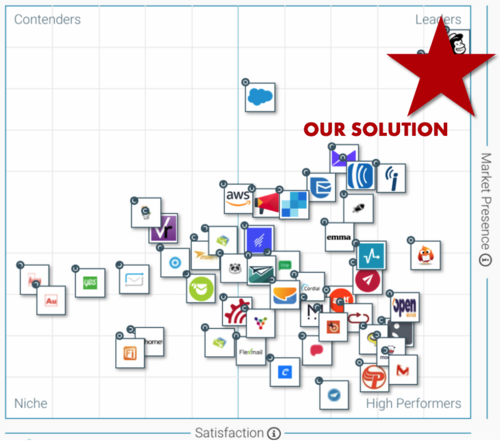
In these meetings, almost every pitch deck has at least one slide dedicated to the 'competitive landscape' and without fail, this landscape shows up as a two-by-two grid with different variables on the X and Y axes (expensive, on premise, hard to implement, etc.). Basically, the attributes are contrived for a favorable outcome and the presenting company magically shows up in the enviable position of the upper right quadrant.
-Marc Andreessen interview on Brian Koppelman’s podcast
These charts, or at least the market research behind these charts, are required, and I encourage entrepreneurs and salespeople to include them in their decks. Because even with clear biases, they provide a framework for a debate on the various merits of the business and solution the company provides.
-Marc Andreessen interview on Brian Koppelman’s podcast
However, there is one competitor that is NEVER on the grid, which is shocking to me in today’s overfunded startup environment. I think this omission is the greatest mistake startups make when thinking about raising capital, and more importantly, the greatest mistake when they’re going to market to win new customers. I would like to introduce this ominous competitor more formally:
-Marc Andreessen interview on Brian Koppelman’s podcast
'Ladies and gentlemen, in this corner, please welcome the undisputed heavyweight champion of the world. The 800-pound gorilla in space. The meanest, nastiness, most diabolic competitor you or your sales team will ever face: STATUS QUO.'
Or, simply put: Selling against inertia (or 'do nothing,' 'no decision') is a bitch. Or, simply put: Selling against inertia (or 'do nothing,' 'no decision') is a bitch.
Most startups simply ignore this alternative, and do so at extreme peril. I see so many companies spending millions and millions of dollars on marketing, branding, sales training and various collateral pieces that all focus on known, existing alternatives in the marketplace. Look at just about any sales deck or website and you will how ABC SaaS company is so much better than XYZ SaaS company based on price, ease of use or other important differentiators.
This competitive analysis is then turned into 'features/benefits' based positioning and messaging, which drives marketing and sales efforts focused on generating leads, communicating the value proposition and determining pricing. All of these efforts are focused on displacing known alternatives. None of this effort goes to attack the real issue for most early stage companies: doing nothing.
In short, most sales – certainly in enterprise – and plenty of pitches are killed by the silent but deadly alternative: Status Quo. Why is it such a strong alternative?
1) Business leaders (buyers) are really, really busy. Per the Andreessen quote above, people are constantly overwhelmed, so doing nothing is always a viable, and almost always preferred alternative. In today’s oversaturated startup landscape, breaking through the noise is really, really hard. So naturally, change is resisted and Status Quo becomes the easy choice.
2) New means that something isn’t working. Something isn’t working means someone – usually a mid-level executive – has to raise their hand and say: 'Yes, I work really hard, I get paid a lot of money and have lots of people that work for me…but I really am not doing my job well, so I need to buy something else.' Trust me, those meetings really don’t tend to go over that well with the CFO. The saying used to go: 'No one ever got fired for buying IBM.' But in today’s world, it’s more accurate to say: 'No one ever got fired for NOT buying the latest and greatest customer analytics tool (i.e. for sticking with the Status Quo).'
3) Pretty good tends to be ok for now (or longer). Companies love to talk about how their product will be something akin to 'life changing,' but the reality is, outside of emergency situations, the current solution is adding some value and is likely keeping things afloat. In short, most of the time pretty good (Status Quo) is good enough. Personally, every time I think about spending $5k on a new Peloton bike, I look at my current alternative (old spin bike + iPhone) and think 'not perfect, but it works.'
The good news? Like most other issues, there is a simple first step to overcoming the oh-so-tempting Status Quo and it really starts with acceptance. Yes, accepting and acknowledging the competitor is the best place to start, and it goes a long, long way in addressing the downstream issues that Status Quo brings to the table. Once you accept this competitor, and the strength of acknowledging it, the following will happen:
1) Your product / solution will be seen in an entirely new light. Acknowledgement of the Status Quo is the first step towards reworking all aspects of storytelling for entrepreneurs, so call out the 800-pound gorilla in the room. You will notice an immediate change in the conversation. By simply calling out the option – 'Hey you could pass / skip this / do nothing' – your audience will naturally see you as more authentic. This acknowledgement alone will spark a much different discussion than previously experienced (even with the same customer or investor), and will set you apart from all the other pitches.
2) You will see your strategic position in an entirely new light. Once you’ve begun integrating the Status Quo into your narrative, you will find that you need to modify your message to address this alternative in all parts of your business: fundraising, marketing, sales and strategy. It might even go so far as to force you to reconsider or modify your entire product or business strategy. While this sounds daunting, it is a much easier and cost-efficient exercise to undertake as opposed to the alternative: the long, slow death of disinterest.
3) Your go-to-market strategy will never be the same. Once you start tailoring your messaging to address Status Quo, you will begin to actually strategize about ways to overcome this competitor in prospecting. Your value proposition will be stress tested and driven to be more specific. This may show up as more exact 'F/U/D' (fear / uncertainty / doubt), more detailed ROI calculations or more extreme positive outcomes from buying/investing in your solution. Whatever it is, some of the greyness will be forced out of the value proposition and it will make your pitch to prospects much more specific and sharp.
So next meeting, do something different. Call Status Quo into your leadership team meeting and give it the proper respect it deserves. Then, just like you would do when any new competitor shows up, roll up your sleeves and figure how to kick its butt. It might not be easy, but beating Status Quo might just be the most important victory that you and your team ever have on your track record.

 1. Be conservative and detailed when you talk about the market you’re addressing.