
Categories
E2E: Scale

Advice for Entrepreneurs on Board Management: Mind the Information Gap

This post originally appeared on Forbes.com on March 28, 2018 where Michael Smerklo is a regular contributor.

This post originally appeared on Forbes.com on March 28, 2018 where Michael Smerklo is a regular contributor.

When you’re a CEO, you have countless things to do every day. You are always pressed for time, you’re being pulled in a million different directions and you’re hyper-focused on growth. So you have to prioritize these never-ending tasks, and it’s only natural that tasks with *seemingly* little value-add get pushed to the bottom of the to-do list. Frankly, that’s how I used to feel about my Board of Directors.

I felt it was a ‘necessary evil’ of my new gig as CEO: one that I knew I had to eventually deal with, but felt wasn’t going to be instrumental in helping my company. I didn’t get much insight from them when we met so why should I dedicate any of my already-sparse time investing in a relationship with them, right? Wrong. I was very wrong.
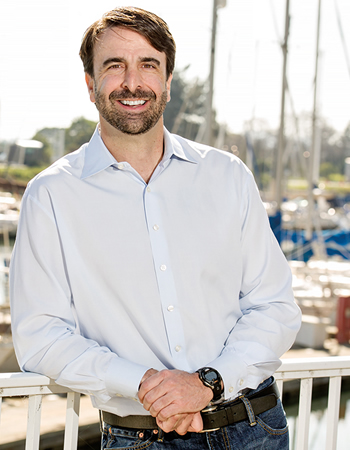
Michael Smerklo, co-founder and managing director of Next Coast Ventures

One, simple conversation with a mentor led me to realize that a Board can be the pivotal difference between success and failure during your entrepreneurial journey. You will be tempted to de-prioritize your Board in lieu of other initiatives that seem more important, and frankly are more enjoyable. Resist that temptation. You just have to take a step back and learn how to handle them and their expertise in the context of you and your company’s goals.

Before I divulge the conversation that changed my perspective on my Board, let me assure I was making classic “Founder moving to CEO” mistake.

For the first few years I was running my company, I didn’t really engage my Board in a strategic manner and kept most of the meetings high-level – making sure that I had every question answered before I even walked into the boardroom. I would fill my Board decks with pages of details on topics I knew I felt were solid, preventing any sort of critical discussion from materializing.

I wasn’t trying to hide anything, I just wanted to ‘check the box’ of my Board meeting as quickly and painlessly as possible because I didn’t understand how to get much from them – individually or collectively. I was treating my Board as an overlord that needed management instead of an arrow in my leadership quiver, and my frustration grew after every Board meeting when I realized these meetings were often interesting, but never compelling.

Although the change in how I approached my Board did not happen overnight, I owe a debt of gratitude to one of my best Board members, Bruce Dunlevie, founding partner of Benchmark Capital, the preeminent venture capital firm in Silicon Valley. Bruce could see what was happening from a mile away – he had seen so many other entrepreneurs fall into this trap – and he could empathize with me and my effort to deal with a powerful Board.

So after one particularly frustrating meeting, he pulled me aside and asked me one critical question that changed how I viewed my relationship with my Board by focusing on what I now call the: ‘Entrepreneur-Board Information Gap.’ He asked:

“Mike, does anyone on the Board know as much as you do about your business? Seriously – how big is the gap between what you know about the operations versus what the Board even understands about the business. Have you taken this gap into consideration when building the Board agenda and supporting materials?”

As I reflected on this question – keep in mind, reflecting on questions like these is not a natural exercise for most entrepreneurs – I quickly noted that I spent at MINIMUM 80 hours a WEEK thinking about my business, while my average Board member thought about the same topic for AT MOST 40 hours a YEAR. This is a HUGE discrepancy, and noticing this delta – this gap – is probably the most important realization for any entrepreneur managing their relationship with their Board, setting an appropriate agenda or building a compelling Board deck.

Simply put, the biggest mistake most entrepreneurs make when working with their Board is not minding the information gap – the Entrepreneur-Board Information Gap, let’s call it ‘EBIG.’

The EBIG dictates one, simple rule: don’t attempt to get your Board up to the same level of understanding as yours, rather, use this information gap to your advantage. That is, being aware of the EBIG and how to leverage it becomes the key to turning your Board into one more arrow in your quiver that will help you build an amazing business.

One specific way that minding the EBIG changed my approach to my Board was learning to strike a balance in my Board materials that was a good mix of key operational updates and open-ended strategic discussion. You will be amazed at how much you can get out of your Board in short order when you stop spending all your time trying to get them up to speed, or wasting time prepping abundant Powerpoint slides in an attempt to answer every question in advance of the meeting.

For instance, I used to spend 90 minutes of a four-hour Board meeting – and hours of prepping the meeting – providing an ‘executive summary’ of the current state of operations of my global business. I thought: How could they really give me any feedback if they didn’t thoroughly understand the state of the business that I worked with every day? But then I thought of the EBIG.

My Board of seasoned executives wasn’t there to dive into the details of the operations. That was a waste of their valuable time, and a waste of mine. They didn’t need those details to understand the big picture of the business and provide me with the high-level insights I was desperately seeking.

Instead, after Bruce’s invaluable feedback and direction, I modified my typical 15-page ‘executive summary’ down to one slide. This slide had three sections: 1) What’s Working, 2) What’s Not Working and 3) Implications (of both). This one-page slide served as the springboard for repeatable, meaningful and open-ended Board discussions thereafter.

So no matter how busy you get, or how much is on your plate as a CEO and an entrepreneur, remember that working with your Board is a non-negotiable part of your job description and a necessary component to making your company successful. So don’t resist their feedback. Instead, take a step back, reflect on where you could use input and present it in a way to make that easy – or as I like to say: mind the EBIG.

Bruce Dunlevie

Building these types of judgment-free relationships is an endeavor that lasts a lifetime, and like any good relationship, having a strong network takes upkeep. It’s an active exercise, not a passive one. Just as you evolve as an entrepreneur, your mentorship circle should evolve as your business and personal needs change.

For example, when I was first getting started, it was critical for me to get advice from those who were highly engaged in startups and understood all the key issues that getting a business off the ground entails. Simple suggestions about hiring, board meeting agendas or what payroll systems work best all helped me avoid mistakes others had already made and also saved me countless hours.

However, when my company was a more mature and I was working to shift my business model, I proactively shifted my mentorship circle.

Whenever I am fortunate enough to retire and look back at the ups and downs of my career, I am going to have a lot of thank you notes to write. Without my mentors, it wouldn’t have just been a dealbreaker for some investors I met along the way, it would have been a dealbreaker for my career. So do some self-reflection, check your pride at the door and seek out those who will be able to make you a better entrepreneur, and a better person. It is the weak leader who believe they need to do it all themselves.

For instance, Ben’s advice on hiring was critical to me when I was going through the startup phase and hiring the first 50 employees. However, the ‘critical’ input I needed running a 3,000 person, publicly traded business was much different. I found myself needing to recalibrate my mentorship network. So I—once again—made sure my humility was still fully intact and proactively sought out seasoned, C-suite executives to help guide me through this new phase of my career.
Categories
E2E: Scale

To Avoid An Entrepreneur’s Biggest Dealbreaker, Find A Mentor

This post originally appeared on Forbes.com on December 5, 2017 where Michael Smerklo is a regular contributor.

Entrepreneurs walking into a meeting with potential investors are usually armed to the teeth with data points about their business idea. Looking to avoid investors’ dealbreakers, most spend hours prepping for questions about their competitors and the market size for their product.

However, when entrepreneurs sit down with me to talk about investing, I ask them two seemingly unusual questions that can make or break my decision:

‘Can you tell me what mentors you have now? How do you lean on these relationships to help solve any key problem you are facing?’

Why hang so much on a question that has nothing to do with a business model? Because unlike any other profession, being an entrepreneur means fully committing to the successes and failures of an enterprise. The roller coaster of emotions that an entrepreneur faces is staggering. There are extreme highs that bring moments of euphoria and excitement, followed quickly by extreme lows—often in the same day—that breed crippling self-doubt.

Michael Smerklo, co-founder and managing director of Next Coast Ventures

It is a heavy, heavy burden and one that you should not bear on your own. In order to not only be able to pick yourself up after these roadblocks, but to move on constructively, you must have one simple thing: a mentor. There is no way around it.

It could be a loss of a major customer, a new unexpected competitor or an unfortunate series of poor judgment calls that can short circuit your confidence and leave you questioning your ability to remain as captain of the ship. Mentors give you the context, guidance and support you need when you may not know how to move forward. Without them, you are blindly riding the roller coaster instead of using the latest GPS technology to navigate the best path.

Now I have to admit, acknowledging I needed to curate a support system to give me guidance during these troubling times in my own entrepreneurial journey was one moment of realization. But being able to actually swallow my pride, ask peers for help and incorporate their advice into my business practices was a whole different obstacle to overcome.

Soliciting this type of help is not a weakness, it is a strength. Pride has no place when it comes to building your mentor-mentee relationships.

I remember early on in my career I took my first operating role with a then-unknown CEO named Ben Horowitz. I was tasked with hiring team members and was frustrated with how many interviews my star candidates were forced to go through just to get an offer. I had always thought I was great at spotting talent and didn’t understand why I was unable to get handle on the hiring process. So I complained to Ben—loudly, as usual—about this seemingly unnecessarily elongated exercise. I will never forget his response. He had seen the culture get eroded at Netscape by a failed hiring process and he was committed not to repeat it, he told me: ‘The first 10 employees are key, they hire the next 50 employees. And once that is done, the culture of the organization is largely set. That is why we are so focused on making sure we all hire great employees from the start.’

That type of advice from a mentor is invaluable and was incredibly important to me not just when I first heard it, but also a few years later when I was starting out as a first-time CEO. But taking that advice meant I had to step back, swallow my pride and recognize how little I knew about building a culture and an organization. Once you have your first powerful mentor-mentee moment like this, it becomes easier to see the value of these relationships.

So now that you’ve realized you need a mentor and you are willing to be open about your self-doubt, now what? Picking an effective mentor requires just as much self-reflection.

There are three things you should look for when tracking down a mentor:

  • Somebody who knows you and understands how you think
  • Somebody who understands the subject matter that you are dealing with
  • Somebody who has the wherewithal to give you objective advice

A mentor that encompasses these three attributes will be able to help you get to the root of the issue, empower you to regain your courage and equip you with tools to go back to doing what you do best: building an outstanding business.

Once I realized that I needed to be on the lookout for mentors like these, I naturally became more enthusiastic, self-aware and open to networking. Sure, I proactively sought out these relationships at industry events or through my existing network, but as I humbled myself and opened up to the idea of asking for help, these beneficial relationships also began to happen organically. It’s not just about blindly asking people on LinkedIn for coffee, it’s about approaching people with as much thoughtfulness and consideration as you would potential investors for your dream business.

As my mentorship network grew, I realized that each mentor offered me a different perspective and that the more data points I had, the clearer my vision was of how to move forward.

That’s why having one mentor is necessary, but having half a dozen is fantastic.

Building these types of judgment-free relationships is an endeavor that lasts a lifetime, and like any good relationship, having a strong network takes upkeep. It’s an active exercise, not a passive one. Just as you evolve as an entrepreneur, your mentorship circle should evolve as your business and personal needs change.

For example, when I was first getting started, it was critical for me to get advice from those who were highly engaged in startups and understood all the key issues that getting a business off the ground entails. Simple suggestions about hiring, board meeting agendas or what payroll systems work best all helped me avoid mistakes others had already made and also saved me countless hours.

However, when my company was a more mature and I was working to shift my business model, I proactively shifted my mentorship circle.

For instance, Ben’s advice on hiring was critical to me when I was going through the startup phase and hiring the first 50 employees. However, the ‘critical’ input I needed running a 3,000 person, publicly traded business was much different. I found myself needing to recalibrate my mentorship network. So I—once again—made sure my humility was still fully intact and proactively sought out seasoned, C-suite executives to help guide me through this new phase of my career.

Whenever I am fortunate enough to retire and look back at the ups and downs of my career, I am going to have a lot of thank you notes to write. Without my mentors, it wouldn’t have just been a dealbreaker for some investors I met along the way, it would have been a dealbreaker for my career. So do some self-reflection, check your pride at the door and seek out those who will be able to make you a better entrepreneur, and a better person. It is the weak leader who believe they need to do it all themselves.

Categories
E2E: News

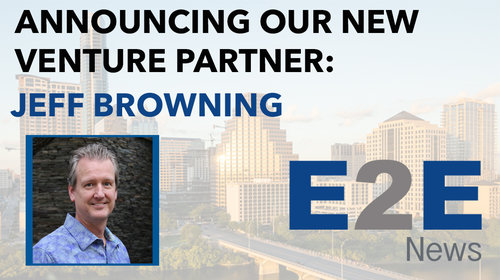
Announcing Our New Venture Partner: Jeff Browning

Today, we are very excited to announce that we are adding Jeff Browning to the team at Next Coast Ventures. Jeff is joining our team as a Venture Partner where he will focus on helping our portfolio companies with all aspects of organizational design, talent acquisition and executive development. Jeff’s addition to our team underscores our relentless focus on building out a firm with a continual thesis around how can we bring the best and brightest minds to the entrepreneurs that we serve.

Jeff Browning

Jeff has 30 years experience in executive talent acquisition across multiple industry sectors and company sizes ranging from startups to the Fortune 100. Most recently, he was a Principal at GTCR Private Equity, recruiting CEO candidates for their prestigious Leaders Strategy Program. Prior to GTCR, Jeff spent 15 years as the Recruiting Partner for Austin Ventures. In that role, he led all the executive talent acquisition programs supporting both the Venture Capital and Growth Equity practice areas.

We are thrilled to have Jeff on our growing team and can’t wait to introduce him to our growing portfolio of amazing entrepreneurs! Building a new business is really hard – we know it from personal experience – and talent acquisition and development is oftentimes the most important part of an entrepreneur’s job. Jeff’s passion and expertise is focused on helping entrepreneurs overcome this exact challenge – and we think Jeff will be a crucial tool for helping our portfolio companies succeed.

Since day one, Next Coast Ventures has been “built by entrepreneurs for entrepreneurs,” and we are hyper-focused on leveraging our network of industry experts to help our portfolio companies reach new levels of growth. Jeff is one more example of this mindset – and his addition will complement the rest of our growing team!

Please join us in welcoming Jeff to the Next Coast team – we are excited to have him and we expect our ass-kicking entrepreneurs will feel the same way!